MS Word and Apple wallpaper madness
A lot has been written in the past few years about how we normalized massive executable sizes for basic software. The flood of Electron-wrapped applications means we all have multiple copies of Chromium weighing down our drives. But it’s not just the web-first startups and indie developers who (understandably) resort to using the fastest-to-make, albeit messy tools. Hands down, I count myself among them. But we get slop even from the biggest players supplying industry-standard software bound to live on most desktops.
My copy of Microsoft Word is 2.63GB. The entire Windows MS Office XP suite which I was growing up with took between 210MB and 450MB. It might be my advanced age but that level of bloat just feels insane. Is MS Word in 2026 really so much prettier and/or more useful than Word XP to justify the 10x-50x spike in space requirements? How much can you improve on a word processor, anyway? Even if the goal is to create FOMO and make people keep on spending money on subscriptions, why make it so heavy?
Just a few months ago, PC World recommended an average laptop user to make sure they have at least 256GB of SSD. After subtracting the space needed for the OS, drivers, the recovery partition, etc. that leaves about 226GB of real estate. That is just over 1% of available space required for the word processor.
We can make a conservative guess that in 2007, the year when Vista was released and started officially replacing XP, an average computer in use in the US had a 60GB drive. Accounting for the Windows XP SP3 which could take up to about 1.5GB on its own, that leaves us with 58.5GB to spare.1 The 210MB standard edition of Microsoft Office XP would contain 5 programs, so 42MB of total disk space for MS Word XP alone seems like a good rough estimate. 42MB out of 58.5GB is 0.07% of total available HDD.
In other words, accounting for technological progress and keeping as much as possible equal, text editing in 2026 takes up 14x more resources than it did in 2007.2 Holy shit.
It is just embarassing for something so basic as the default word processor on the market to become so much less efficient over 20 years of constant and well-funded development. It is everywhere, too, not just in visually demanding flagship apps like MS Office.3 And yet, today I realized Microsoft got beat in its disregard for efficiency by another tech giant flush with cash, and with something even more basic than a text editor.
Behold the 1GB+ wallpaper:
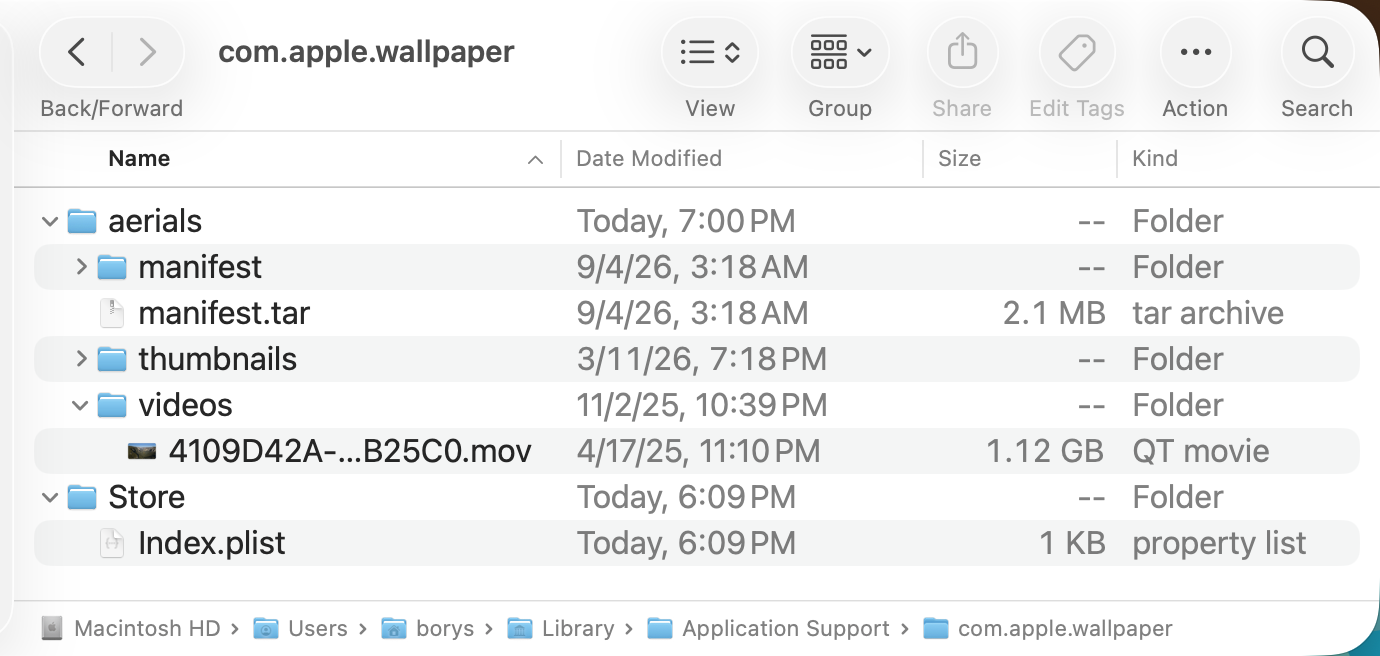
Yeah, those aerial views that move for a second when you turn the screen on are pretty nice. But holy smokes, I thought they were some super high-res gif files or maybe short video clips they somehow enhance with hardware on the go. Instead, it is a full 10 minute long .mov file that weighs 1.12GB. For a wallpaper you might or might not use to look at on a 14in screen for a few seconds once in a while. The entire demo scene would rather self-destruct than ship such an abomination.
The more I see lazy solutions like that, the more I want to switch to something like the whimsical and infinitely portable UXN virtual machine.
-
(Mind you, that is an estimate of the status quo at the time. To make the comparison actually fair we should probably use the size recommended at the time, which – according to the same article – should be somewhere between 160GB and 250GB, if I interpret it correctly. But let’s give Microsoft in 2007 the benefit of the doubt.) ↩︎
-
(I leave the comparison of memory requirements as an exercise to the reader. ;) ) ↩︎
-
A similar explosion in size happened for the barebones Notepad too: https://www.windowslatest.com/2026/07/04/ex-microsoft-engineer-rebuilds-notepad-in-2-5kb-using-nothing-but-stuff-windows-already-had/. ↩︎